Friday, May 29, 2015

The day it all came together

“When the day of Pentecost had come, they were all together in one place.”

                                                                                                Acts 2:1
            With all the hub-bub and holiday bling associated with Christmas and Easter, it’s easy for other church festivals to get left behind.  Think about it: between Christmas and Easter we have Epiphany, Ash Wednesday, Maundy Thursday and Good Friday… none of these have really worked their way into our culture’s consciousness the way Christmas and Easter have.  Then there’s this “second round” of festivals between Easter and Christmas, festivals that focus on the life of the Church: Pentecost, Holy Trinity, Holy Cross, Reformation, All Saints and Christ the King.  If you talk to someone who doesn’t attend church regularly (or attends a non-denominational or non-liturgical congregation), chances are they’ve never even heard of these seemingly second fiddle celebrations.  And yet, each one tells a significant story in the unfolding drama of the Church year calendar. 

            Perhaps these important days are so overlooked because their stories are so difficult to tell.  Everyone can understand Christmas, right?  A baby is born.  That’s not hard to figure out.  So what if he happens to be Son of God and born of a virgin, destined to die for the sins of all humanity, rise from the dead, and ascend to heaven to rule the universe?  We don’t have to worry about all that as long as we keep him in the manger.  Easter isn’t too bad either, but too many people focus more on rabbits and candy than the actual meaning of an empty tomb and Risen Savior. 

            But what about Pentecost?  What do we say to the world when we tell the story of Pentecost?  Who can blame people for shaking their heads at what sounds like a tale of an invisible tornado and people catching fire?  Which of us has ever been in a crowd of thousands where everyone starts speaking and communicating in other languages?  What do we say about a day in history when the main event was something supernatural?

            The coming of God’s Spirit upon God’s people, Pentecost was the opening of a door, the meeting and melding of minds and hearts, the spontaneously combustible constituting convention of the holy catholic Church.  Every bit as much a work of God as the birthday of Jesus and the rolling of the stone, Pentecost was the moment it all led up to, the day it all came together.  What we do on Sunday mornings or whenever we come together as Christians, what stirs in our hearts when we pray, and what guides us in faith each and every day… these are all results of what happened so gloriously and unexpectedly on Pentecost.  In fact, our whole life in Christ is a continuous unfolding of Pentecost and a continual outpouring of the Holy Spirit.

            We see it and celebrate it in ways that may seem tame at first glance.  The gifts of the holy Spirit are, for the most part, unspectacular.  So are fireworks, before you light them.  Several places in scripture, we are given example lists of these gifts.  “There are,” St. Paul tells us, “varieties of gifts, but the same Spirit…to one is given through the Spirit the utterance of wisdom, and to another the utterance of knowledge through the same Spirit, to another faith by the same Spirit, to another gifts of healing by the one Spirit, to another the working of miracles, to another prophecy, to another the discernment of spirits, to another various kinds of tongues, to another the interpretation of tongues…”  (1 Corinthians 12).  Elsewhere, he says “we have gifts that differ according to the grace given to us: prophecy in proportion to faith; ministry in ministering; the teacher in teaching; the exhorter in exhortation; the giver in generosity; the leader, in diligence; the compassionate in cheerfulness” (Romans 12: 6-8).  These gifts can look like everyday talents, but what the Spirit does is fit them together so that we all become part of something so much bigger than ourselves, we are set aflame and, as Jesus put it, “our lights shine before others” (Matthew 5:16).

            Pentecost is what lights our lights.  Dreaming dreams and seeing visions, being enthusiastic architects of a better world is now the business of every Christian.  These different gifts work in different ways, but always for the purpose of bringing God’s healing and love into more of the world.  We learn from Pentecost that ministry about working together.  We are all connected, all part of the body of Christ.  We all need each other to function at our best.  In the church, we strive to give everyone a part, not just so we share the load but also to find a place for each particular gift.  We enrich our congregation and build community by helping more people get involved in fellowship, worship, and service.  That could mean thinking outside the box when it comes to the ministries we do.  Even if we’re covering all the bases, if there are new people who want to be in on the game, maybe it’s time to change the game and add more bases.  No matter what, we try to do each ministry with a “servant’s heart,” sensitive that we are part of a larger team working for the good of the whole.


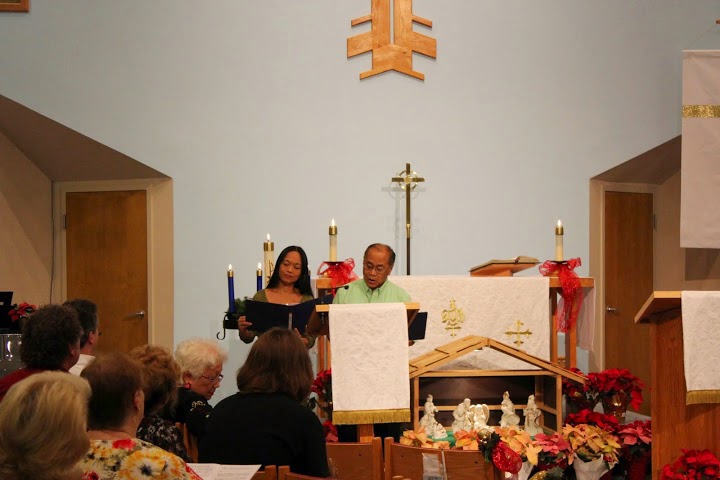
            As usual this Pentecost, we celebrated our confirmation ministry at Atonement.  The four young people in confirmation each shared a presentation using the gifts God gave them to tell the story of their faith.  Joshua Diemer presented a powerpoint he called “The Church as a Team.”  He showed that the different roles and tasks in our congregation are similar to roles you’d find on a sports team, with a leader (pastor), coach (God), ball carriers (volunteers), medics (helping ministries), and even announcers (powerpoint makers), and fans (everyone who goes out and spreads the Word).  Nicholas Trejo spoke about ways the Church has changed and adapted over time, taking new shapes and forms and using new technologies.  He pointed out that having a Bible app is a revolutionary new thing, but so was the Gutenberg Bible and being able to read Scripture in your own language.  Z’Leah Liburd sang a moving song that included the words  “I give myself away (so You can use me).”  Accompanying the song was a slide show of pictures that depicted her volunteer work in the church, and other achievements she has made despite being visually impaired.  Alex Rivera-Matos, the one being confirmed that day, talked about the way his faith shapes and influences his own personal life.  He shared ways that music, prayer, and sports shape his own priorities and relationships, and helps him feel closer to God.

            How wonderful to see young people living out their faith with enthusiasm and creativity.  Clearly, they get it!  Several people stopped me on the way out of church that morning, telling me how impressed they were with these young people, and how clear it was that God’s Spirit was at work in, on, and through each of them.  One person told me, “These kids have a lot to teach our whole congregation.”  Let’s learn a lesson from them, and stay fired up for God this summer!

 
Peace,
Pastor Scott

Monday, May 25, 2015

Thoughts at half a century

            “A pleasant vineyard: sing about it!”
                                                                        -- Isaiah 27:2

            So this month I turn 50, which doesn’t seem right.  50 once seemed like a big number of years, just like 50 dollars once seemed like a lot of money.  But somewhere on the way to 50 years of living, all that changes.  In my younger days it was said that the average American male lived to be 65 years old.  Today it’s near 76.  Either way, I’m less than a long-term mortgage away.  Kinda makes you look back at your life and simultaneously wonder what else could be coming along the road in the years of living you have left.
            The 2015 we all live in would have surprised the younger me in many ways. The younger me would be amazed at the infectious spread of strip malls, big box stores and superstores like WalMart.  Spending hours in the library after school in sixth grade, how could I have guessed that all the books and encyclopedias in the reference room would one day be surpassed by something called the Internet – which anyone could access through something called a laptop, or carry in their pocket on something called a smart phone?
            Many things I expected to have happened by now never did.  We don’t have a national network of high speed rail, or fleets of Concorde planes, much less astro-cruises to the asteroid belt.  We still have brutal wars, but at least they’re not nuclear.  We still have hunger and disease though life expectancy continues to increase.  Going by predictions from my childhood, I’d have expected that by now we’d all be living in underground houses powered by clean solar energy.  The furniture in the model “house of the future” I visited long ago looked like the stuff you’d buy today for the kids’ room at Rooms 2 Go.  And you never could have convinced my 11-year old self watching the movie Star Wars for the first time that the most eagerly anticipated movie in the year I turned 50 would be the latest sequel to that same movie.
            I’m not sure anyone could have foreseen the way technology has become so intertwined with every aspect of our lives.  And who could have predicted the frustration of instantly obsolete electronics?  We pay big money for items and services that do amazing things, but are designed by companies that know how to get us hooked and keep making money off of us.  The latest and greatest hardware becomes junk in a few years when it can no longer run the new software.  Services we once had for free suddenly upgrade and start charging us. There was a day my kids will never know when we got our television channels from the airwaves, not cable or satellite… for free! 
            And look how communication has changed.  People can watch our church services live on the web.  Heading to the store, I can text my wife on the way out the door and by the time I get there I have a list of groceries to pick up.  Social media makes it fun to share personal information.  We feel like celebrities starring in our own tv show, at the same time getting instantly fed the latest gossip.  More than that, it feeds our real human desire to connect with other people.  We can know when someone we care about is in the hospital as soon as they go in, and be praying for them right away. 
            When I was in high school, we were required to read 1984 by George Orwell.  In this book, Orwell depicted a grim world with everyone under surveillance.  We talked about it in terms of what the Soviets were doing, never imagining we’d be doing it to ourselves.  The amount of information that can be collected about us today is staggering.  There was a day when the thought of handing over all your receipts, photos, copies of all your messages and recordings of all your phone calls was unimaginable. Now we assume that someone somewhere is collecting all that data.  Who could have imagined the day when everyone would be carrying around a tracking device that could reveal their position at all times?  Today we happily carry our cell phones with us, along with their built-in GPS locators.  Do we feel safer and more secure with all this technology, or more and more lost in a world that is slipping beyond our comprehension? 
            It’s fun to imagine the future, but a spiritual perspective is needed if the world is really going to become a better place.  Technology and change are not necessarily good or bad in and of themselves.  What matters more is how these things are used, and how they are made available.  The Bible gives us a vision of a just world and shows us how we fall short.  Time and time again, humanity has been like a vineyard well cared-for by God, but yielding sour grapes (Isaiah 5).  Until the day Christ returns there will always be outrageous evil in the world and in our selves.  But in my 50 years I have seen outrageous good triumph in numerous ways.  The Spirit of Jesus is at work in the loving and forgiving done in his name.  The triumph of Easter is revealed in the healing that takes place every day as people come together with the good news of a God whose love is the same yesterday, today, and forever. Any sour grapes left over from our past are not what God keeps in his heart.  When God speaks of that beloved vineyard later on in Isaiah, he says,
             “I the Lord am its keeper; every moment I water it.
            I guard it night and day, so that no one can harm it; I have no wrath.” (Isaiah 27:3-4)
God’s never giving up on us.  He has placed us in this vineyard of the Church to help us invite others into the vineyard of our lives. 
            After 50 years I’m more sure than ever that what the world needs most is this message we carry that grace abounds!  Hope lives in the sharing and giving that happens through and within the family of faith.  A better future for each of us and for this planet rests in the Good News of the death, resurrection, and eternal rule of Jesus the Savior.  How blessed I am to be turning 50 in Florida, surrounded by a congregation that wants to roll up its sleeves and carry that message forward.  With the sweet sunshine and rains sent by God, may our vineyard grow the luscious grapes that yield the best wine of all.

Peace,
Pastor Scott

Sunday, April 26, 2015

Giving joyfully

“Do not worry about tomorrow…          -- Matthew 6:34

Friends of Atonement,
          Thanks again for your faithful stewardship and generous giving.  2015’s income has allowed us to keep up with expenses while passing the 2/3 mark of our capital campaign.  The campaign has begun counting down to our goal with less than $100,000 to go by our target date at the end of February 2016.  Though giving usually goes down in these approaching summer months, the words of Jesus remind us not to worry about tomorrow. They also remind me of a story…
            A man started a fight with two other men, and the police came and took the guy to jail. The next day the man went before the judge. The judge asked the man, “Where do you work?”   The man said, “Here and there.” The judge asked, “What do you do for a living?” The man said, “This and that.”  The judge then said, “Take him away.” The man said, “Wait, judge when will I get out?” The judge said to the man, “Sooner or later.”
            We live with lots of uncertainty in life, especially when it comes to money.  We’re not sure how the economy will do in the future, how much costs will go up, or just how long we will be able to work.  Even with regular retirement income, we might worry what we’d do if something catastrophic happens.  With responsibilities to care for family members or maintain a household, the command Jesus gives us not to worry about tomorrow may seem harder than any others, including any of the 10 commandments.
            I spoke with a Roman Catholic lady last week who, in the middle of our conversation, gave a testimony about giving.  Making her offering has always been very important to her, she said, though she never knows from month to month how much she’s going to make.  She waits to see how much income the Lord gives her to work with each month.  Then at the beginning of each new month, she makes a check out to her church for 10% of what she made the month before.  
            She had two points to make about her method of giving: #1 – By basing her giving on what her income was the month before, she was always giving as God has blessed her.  #2 – By writing her check at the beginning of the month, she was putting her relationship with the Lord ahead of other bills, making it her first priority.  On rare occasions when emergencies came up and she couldn’t make the whole amount, she would make it up later.
            Everybody’s financial situation is a little bit different.  Some people might have a fairly low income, but lots of other assets.  Some people are well off, others don’t have much of anything, but everyone can give something as they are blessed by God.  Like the widow Jesus pointed to putting two coins in the Temple offering, we can each find a way to give that is a true expression of our love for our giving God.  For me that means giving a set tithe of my income to Atonement, which I do through the automatic Simply Giving program.  I then find ways to supplement that giving as opportunities arise. 
            The point is not so much what you do as how you do it.  Regular giving is a spiritual practice just as much as regular praying and regular worship.  These are all acts of faith that not only build our relationship with God, they also help us quit worrying.  Though she gave different amounts each month, the lady who gave me her giving testimony didn’t just give “this and that,” “here and there.”  She gave purposefully, as an act of devotion and love to the God who had blessed her. 
            That is my prayer for you as well - that when you give, you always give with joy and love.  And after you have given, all your worries are drowned in faith and hope.  We are resurrection people – Easter people, blessed to be a blessing with no cause to worry.  After all, if Jesus could take our sins and exchange them for new life, imagine what He can do with our good stuff?
 
Peace,
Pastor Scott

Thursday, April 9, 2015

On the Way

“And very early on the first day of the week, when the sun had risen, they went to the tomb.”
                                                                                                                                    -- Mark 16:2

            The green palm branches wave in the air; the bitter taste of wine lingers on our tongues.  From a raucous procession through the gates of Jerusalem to a hushed and darkened upper room, from the passionate prayers of Jesus in the Garden of Gethsemane to the courtyard of the religious and governing officials…from crowds hailing him as king to crowds crying, “Crucify him!” we begin April with the conclusion of Holy Week and the textures, symbols, tastes and smells that bring us into that story.  On Good Friday, the dry stiff wood of the cross reminds us of the hard truths of sin, and the penetrating nails recall the pain of Jesus’ sacrifice.
              Good Friday will be April 3 this year, and at noon that day we will be adding a new service to our worship experiences at Atonement.  The Way of the Cross is a based on the traditional Stations of the Cross, signposts of the path Jesus took to and through the crucifixion.  Around the sanctuary we will place pictures representing each of the key moments in the story of Christ’s passion.  These “stations” depict Christ’s suffering from when he was condemned to death to when he was laid in the tomb.  We will travel from one to another, following the way that Jesus took, stopping for prayer and Scripture reading at each.  You are welcome to join us Good Friday for this special service, along with our usual Good Friday service at 7pm.
            Our evening services for Maundy Thursday and Good Friday will continue the series we have experienced all through Lent centered on the parables of Jesus.  Each of these little tales that Jesus tells reveals something new about who he is and what he has done for us.  Jesus tells the story of a great banquet where all the guests skip out.  With the intended guests absent, the host has the servants go out into the streets and invite whoever they find – the poor, crippled, blind, and lame.  This “broken” banquet becomes the celebration of God’s kingdom – a parody of a fancy, 4-star, “a- list” extravaganza.  This is who we are when we come to God – broken ones who have been invited into something we were never fit for ourselves, but because of the hospitality of the host, we find ourselves welcomed and given a place.
            The parable for our Good Friday service will be the story of a landowner who leases his land out to tenants.  He had a beautiful vineyard on that land, which gave sweet and luscious fruit.  There was a fine fence and a tall watchtower, and a press for the grapes.  Things were all set up for the tenants to harvest those grapes and make fine wine – all the landowner wanted was his share of what they produced.  So the day came for the owner to collect his share, and he sent a slave to receive it.  Instead of welcoming this servant of their benefactor, instead of treating him as an ambassador of an ally or as the messenger of a friend, they beat the slave, sending him back to his master with nothing but bumps on his head and a bruised ego.  The master sent another slave, and the same thing happened – then another, and another – each and every servant was beaten and sent away, or else killed.  Finally the master makes a risky decision: “I’ll send my son!  They will respect him, I’m sure.”  But the master has made a horrible miscalculation, and the evil that his tenants began gets capped off with the murder of the landlord’s beloved son. 
            While Jesus tells these tales, he is telling his own story and ours as well. Before he went to the cross, he let us know about a God who was so in love he sent a son, who in love opened his banquet hall to all, and who in love gives life beyond life.  At our 8am service on Easter, we will hear a final parable.  This one is about a pair of men who both build houses.  They both work hard putting up their houses.  They both use the best materials they can find.  They both follow the best plans available.  Only, one man’s house is built on a rock while the other is build on sand.  Their passion and commitment and investment are identical – the only difference is where they started.  A storm came like a Florida hurricane -- with unrelenting rain beating down on the roof from above, and fierce winds battering the walls from the sides.  When morning came, the house on the rock was standing strong, but the house built on sand… As Jesus said, “Great was its fall!”  Death did its worst to defeat Jesus, to wash him away in its flood of destruction and sweep him out to sea.  But in the morning, Easter morning, it was death whose house came crashing down. 
            God has a place for us in this Easter story.  Around the table Maundy Thursday, receiving bread and wine that are more than bread and wine… at the foot of the cross on Good Friday, mourning our beloved Lord and leader, our God and friend…at the garden tomb with Mary Easter morning, gaping through the opening at the emptiness inside, wondering at what has just happened and what that means for my life from this moment on.  This is your story as you face the awesome reality of resurrection, a story of the amazing possibilities that exist for all who trust in the God who created and redeemed all things. 
            The green palm branches wave in the air; the bitter taste of wine lingers on our tongues; the raw wood of the cross reminds us of the hard truths of sin, and the penetrating nails recall the pain of Jesus’ sacrifice.  The symbols of Lent reach a minor key climax in Holy Week, only to transpose into the major crescendo of Easter.  Suddenly, everything changes.  Life is restored.  Hope returns.  The life we thought we were living all along, the one where death is the end of it all, wasn’t the true life after all.  Here is something new, and our world can never be the same.  All this time we’ve been travelling through a long dark tunnel, but now we’ve reached the tunnel’s end and have burst out into the light.  Come along for the ride.  Jesus is risen: Hallelujah!

Peace,
Pastor Scott

Thursday, February 26, 2015

Who cares?

“Jesus came and took her by the hand and lifted her up.  Then the fever left her, and she began to serve them.” – Mark 1:31

            Grabbing her by the hand, Jesus lifted Peter’s mother-in-law out of bed.  Sitting upright, she felt the dangerous fever that had been keeping her down melt away.  Her body cooled, her head cleared, and immediately she rose to her feet with a smile involuntarily brightening her face.  In that instance, she passed from burdensome weariness to a lightness of being that made her want to jump, to dance, to share her newfound energy with the world and those around her.  God’s healing made her want to serve.

            It was the #1 result of our “Asset mapping” planning meeting last fall – it was the ministry with the most post-it notes on the wall and the most people voting with their feet to stand beside the project that they would most want to help with.  Caring.  This is what our church should be doing, they said.  We should be looking after each other, keeping in touch with those who are sick, visiting those in the hospital or homebound, taking meals to those who are incapacitated, providing transportation for people having trouble getting around.  Sure, that stuff happens here and there, now and then, as friends and neighbors care for the ones they know, but what about the others?  What about the people on the margins of the congregation who we haven’t seen for many Sundays and who we don’t really know how they’re doing?  What about the people who fall through the cracks?

            Jesus was just passing through Capernaum.  He wasn’t going to settle down in that city and start a hospital, though he did hold a public healing session there.  Word had spread, and the populace came and brought their sick and disturbed friends and family members, and Jesus spent the evening praying over them and curing them.  Physical maladies were healed, demons were cast out, broken lives were put back together.  But in the morning, after a high-level conference between the Son of God and his Abba, Jesus told his disciples it was time to move on. 

            Some may have felt that it was unkind of Jesus not to stay and take care of the sick who remained in Capernaum.  He could have spent years there just tending to the needs in that one city.  He could have spent a lifetime there.  But just like Peter’s mother-in-law, who wasted no time helping others after God restored her health, Jesus left behind a host of people who had received healing who were in the perfect position to help the others.  They may not have the ability to restore sight to the blind, or to make the lame walk.  They may not be able to banish a fever with a single touch the way Jesus could.  But they could sit with, tend, pray for, and care for those around them.  They could engage in caring ministry, and be extensions of Christ’s own healing presence.

            We who have known the touch of Jesus in our lives, who have been lifted up in many ways by the love of our savior, are called to caring ministry.  As Christians, we understand that all people have value and are loved by God, especially the vulnerable and weak among us.  Because of the care and well-being given us by God, we are able to share our time, prayer, knowledge, and resources in service to those in need.  We love because God first loved us (1 John 4:19).  We are able to care because we’ve been so well cared for ourselves.

            I’m not entirely comfortable with the word “wholistic” because it often gets applied to some flaky concepts in the non-traditional health field.  But the basic idea is sound – our body, mind, emotions, soul and spirit are all linked.  We are each one being, one whole, but at the same time none of us is entirely whole when any of those things is off balance.  Care for others, or for yourself for that matter, involves looking at the whole and finding ways to bring it together and maintain balance.  Peter’s mother-in-law was no doubt very much like many in our congregation.  I imagine she was a doer, a go-getter, used to keeping the household in order, more comfortable with taking care of others than being taken care of.  Her fever slowed her body down, made her feel miserable, and kept her from doing the things she loved to do.  And the more those things remained undone, the lower her spirits sank.  The lower her spirits sank, the less able she was to fight off that fever, and down and down she spiraled.  Until Jesus.

            This is where Caring Ministry comes in.  Even without miraculous powers, ordinary people like you and me can release the power of God’s love by standing by people who are sick and in distress.   Simply by supporting them, spending time with them, helping them with little chores and tasks, we can make a big difference.  And what price can you put on making a new friend? 

            Karen Erickson and her husband Paul, who recently joined Atonement, have been leading the newly formed Caring Team.  They have met with the team twice already, and are well on the way towards laying the groundwork for some important caring ministries.  The caring team also touches on Parish nursing ministries, Stephen’s ministry, Eucharistic ministry, and a host of other areas where we have room to grow as a church.  Parish nursing involves bringing health and wellness awareness and resources to our members.  Stephen’s ministry is an in-depth training program for people who want to work closely one-on-one with people in crisis.  Eucharistic ministers bring communion to our homebound or hospitalized members on a regular basis.

            A Christian man was traveling on an airplane.  The lady sitting next to him asked him what he did.  “I work with a world-wide, multi-national, multicultural organization,” he said.  “We have outlets in every country, and every major city.  We run hospitals and relief agencies.  We care for people – body, mind and spirit, and we specialize in personal development and self-improvement.”  “Really!?” his seatmate exclaimed with genuine wonder.  “What is it called?”  “The church,” he said.

            We are all privileged to be part of this amazing global network of servants.  We have been cared for by a God who made us and a Savior who shed his blood for us.  We are called to reach out and carry that love to all in need.  If we don’t care for them, who will?  As we contemplate how the ministry of caring will be a part of our lives, we require a wisdom and guidance that will not steer us wrong.  A high-level conference with our Abba seems in order.

Peace,
Pastor Scott

Always learning

When Jesus spoke again to the people, he said, "I am the light of the world. Whoever follows me will never walk in darkness, but will have the light of life."               --  John 8:12

            Who was your favorite teacher?  Was it a parent, or coach?  A schoolteacher who spent extra time with you?  Maybe a friend who listened and gave you advice, or an adult who took you under their wing when you were young?  I had many wonderful teachers in my formative years.  My sixth grade teacher taught me to love reading, and my eighth grade English teacher encouraged my writing.  My college instructors helped me find answers to some big questions, and my professors in seminary helped me clarify and strengthen my beliefs.  I continue to learn from colleagues and the extraordinary pastors I’ve had the privilege to know and observe. 

            But I’d have to say my favorite teacher is my father.  Not only did he influence me in many ways through the patient, loving way he treated me, but even today he is someone who is always learning and sharing what he learns.  When I was little, he’d read to me – not just children’s books, either.  As I got older, he’d sit patiently and give me little lectures on electronics and music, history and other cultures.  He tried teaching me German long before I took it in High School.  He showed me how to take pictures and develop them in a dark room.  He introduced me to spirituality, and the idea that God is bigger than any of our ideas about God.

            The most important thing I’ve learned from all these teachers is that we all have a lot to learn, both from and about the one teacher who stands apart – Jesus of Nazareth.  He was surely the most interesting man in the world, and the greatest teacher of all time.  We know he was called “rabbi” which means teacher, but what exactly did Jesus teach?  We know people were amazed at what he said, and followed him because his teachings were unlike anything they had heard before, but what did they hear that fascinated them so much?

            Fundamentally, Jesus taught that people could live a life defined not by their human birth, but by their relationship to God.  To do that, we could be “born again” and undergo a re-centering of our lives.  His contemporaries had trouble understanding this, even those he spoke with face to face (John 3).  He explained what life re-centered in God might be like in his famous Sermon on the Mount.   Going back to the Scriptures and the Laws of Moses, Jesus presents the Jewish tradition not as a set of rules, but as a fresh way to live and as attitudes which reflect the kingdom of God. 

            It was still difficult for Jesus’ listeners to grasp what a radically new proposal he was making.  People crave rules and instructions where everything is all spelled out for them.  But Jesus wanted us to break free of the constraints that go along with living under the Law and find a new freedom in faith.  So instead of “how-tos” or “dos and don’ts,” Jesus gives us parables. 

            The parables are seemingly simple stories that illustrate aspects of our relationship with God and others.  When the disciples asked Jesus why he spoke in parables, Jesus said, “The knowledge of the secrets of the kingdom of heaven has been given to you, but not to them. Whoever has will be given more, and he will have an abundance. Whoever does not have, even what he has will be taken from him.”  In other words, the parables communicate their wisdom only to those who are ready for it, open to it, and accepting of it.  Along with his Sermon on the Mount, the parables of Jesus contain his most profound and powerful ideas.

            This Lent, we will be exploring some of these teachings of Jesus in a series of special services called the Parables of Lent. From Ash Wednesday (February 18) through Easter Sunday (April 5), these services will focuses on a biblical parable that connects to Lenten themes.  Coming up in February, the Ash Wednesday service is based on the parable of the Pharisee and the tax collector. In this parable, the tax collector who repents goes home justified, while the proud Pharisee does not. The parable reminds us that we who repent are justified through Christ. Week One in the series (February 25) is based on the parable of the sower and the seed. In this parable, the seed that falls on fertile soil takes root and grows, while seeds in other soils fail.  This parable teaches that when we are open to receiving it, the Word of Christ flourishes within us.

            You’ve heard the saying, “You learn something new every day.”  Hopefully, you find that to be true.  The life in Christ is an invitation to always be learning, always growing in understanding and wonder.  Come and join us Wednesdays in the season of Lent as we hear the words of our greatest teacher, and seek ways to follow him in our world today.

Peace,
Pastor Scott

Thursday, January 15, 2015

Pearls of great price

“Yet whatever gains I had, these I have come to regard as loss because of Christ.  More than that, I regard everything as loss because of the surpassing value of knowing Christ Jesus my Lord.  For his sake, I have suffered the loss of all things, and regard them as rubbish in order that I may gain Christ and be found in him
                 -          Philippians 3:7-8

Friends of Atonement,

            A lady recently went on Antiques Road Show to show off her collection of baseball cards, which she inherited from her great-great grandmother.  The Boston woman had found the cards, some of them autographed, sitting in a desk drawer.  They depicted players from the 1871 Boston Red Stockings team, which later became the Atlanta Braves – players such as Al Spalding (later to found Spalding Sporting Goods) and Hall-of-Famer George Wright.  With tears in her eyes, the appraiser from the show told the lady on air that her collection was worth about $1 million – making it the most valuable sports memorabilia they’d ever seen on the show.
 
           Jesus once spoke of a “pearl of great price” (Matthew 13:45-46), not just a valuable treasure, but one that would be worth giving up everything you had just to own.  How could anything be that valuable?  It’s hard enough to convince an avid golfer to leave the green, a fishing enthusiast to put away his poles and row for shore, a sports fan to turn off the game, or a music lover to give away her tickets to her favorite band?  Imagine leaving behind everything for a single priceless treasure!  Could you even imagine finding something so wonderful that everything else you valued in life seemed pale by comparison? 

            That’s just what the apostle Paul said about his experience of coming to know Jesus.  Once he realized that Christ is the one who brings all joy, light and beauty to the world, he said he’d gladly set all else aside to keep the Lord in his life.   For the Antiques Road Show appraiser, those old baseball cards were much more than a quaint family memento.  To a proud grandmother, a grandchild’s penciled portrait stuck on the refrigerator is more precious than the original Picasso hanging in the hall.  Those who live by the power of faith wouldn’t trade it for a winning Powerball ticket.

            In Christ we are all blessed beyond belief, and knowing Him makes us more than millionaires.  In this season of Epiphany, we celebrate the treasure of knowing Jesus as our friend and Savior.  As Christians, we’re all called to follow him, just as Peter, James and John did when they left their nets and became “fishers of men” (Matthew 4:19); as Philip and Nathanael did when they realized Jesus was our earthly link to God (John 1:51).  But does that mean we have to be like the apostles and walk away from everything in our former life?  Are we supposed to give up everything to possess this pearl of great price?

            God calls us to pursue the life we find most valuable and worthwhile.  He doesn’t ask us to give up beauty and joy, but to find beauty and joy in and through Jesus.  That probably doesn’t mean giving up your house and family or your leisure and fun, and it certainly doesn’t mean to turn away from your responsibilities to others.  However, our desires and priorities should all obey the law that God writes in our hearts (Jer. 31:33) directing us to want Him above all else.

            Your offerings reflect this desire for God which He has placed in your heart.  You could easily spend that money on food, a few rounds of golf or a couple trips out to the movies.  You could put it towards the mortgage, fly up and see your niece or spend it on any of the millions of entertainment options we find here in Florida.  And of course there are countless other charities and worthy causes that invite your donations. 

            But there’s a difference between a donation and an offering.  An offering is a sign of our gratitude to our Lord.  We’re acknowledging that He has come to be our Savior, our King of Kings and Lord of Lords -- our “One Thing Needful” (Luke 10:42) and our “Pearl of Great Price.”  And yet, Jesus still allows us to keep everything else on top of that, hoping that we will use it all for the good of others as well as ourselves.  Obviously, for a Savior like that we should give our best, and give with happy and generous hearts.

            This is exactly what I see happening at Atonement.  People keep putting aside lesser things in their lives in order to help and support the work of God going on at this church.  Just as a family functions by everyone chipping in, this congregation has been able to grow, to reach out, and to serve more people in more ways through the generosity and gratitude of each one of you.  As 2015 presents us with new opportunities for serving our community, I hope it also gives you a new appreciation for that priceless pearl that was placed in your hand through your baptism and new life in Christ!


Thanks for all you do and may God’s grace abound in and around you in this new year!